
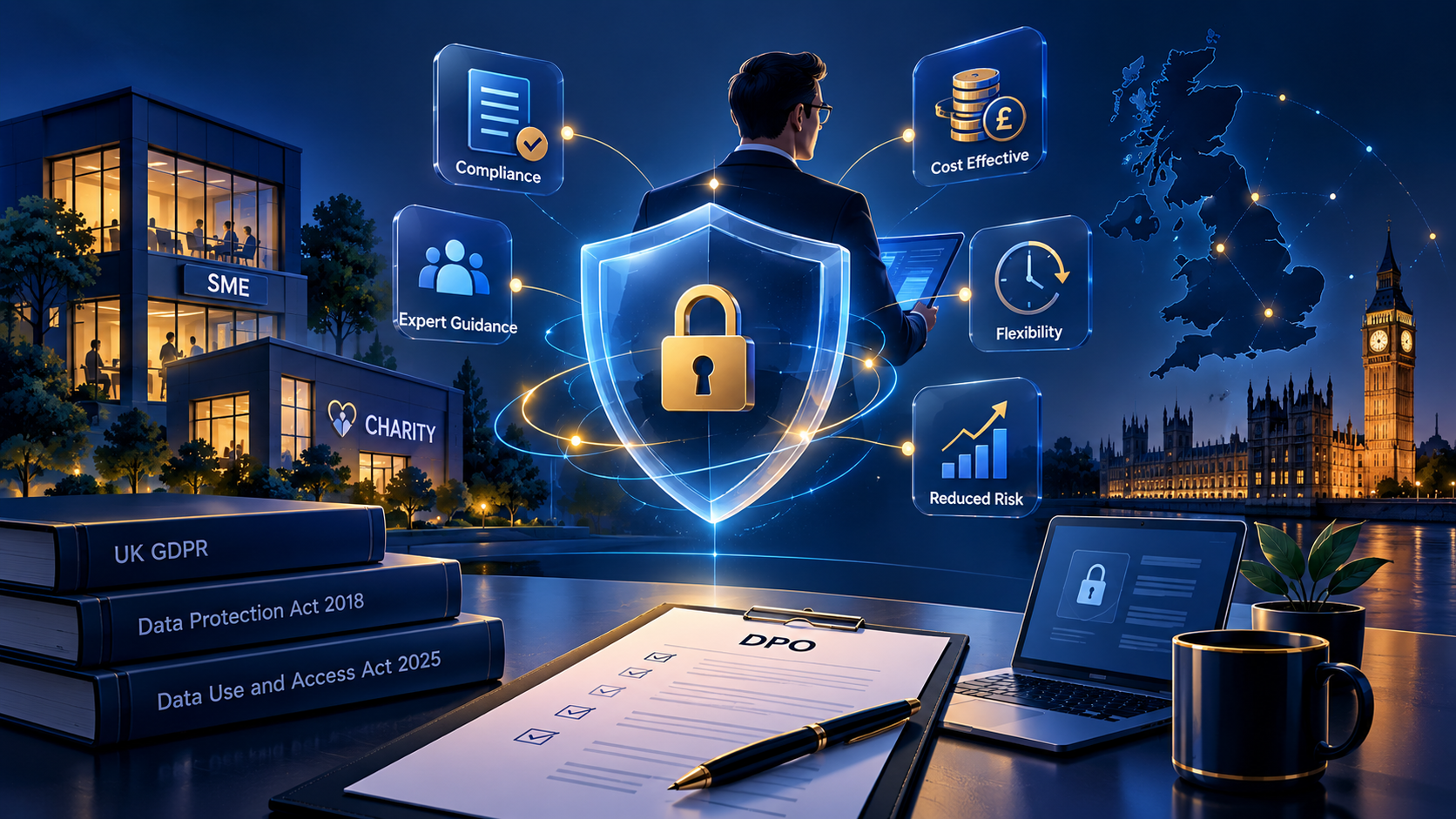
The role of Data Protection Officer (DPO) was introduced by GDPR and carried over into UK GDPR. For organisations that are required to appoint a DPO: and increasingly for those that choose to appoint one voluntarily: the question of whether to hire in-house or outsource is a significant one.
For most UK small and medium-sized businesses and charities, outsourcing the DPO function is the more practical, cost-effective, and often more effective choice.
When is a DPO required?
Under UK GDPR, a DPO must be formally appointed if your organisation:
- Is a public authority or body
- Carries out large-scale, systematic monitoring of individuals (for example, online tracking or CCTV monitoring at scale)
- Carries out large-scale processing of special category data (health, biometric, genetic, criminal offence data, and so on)
Many SMEs and charities fall outside these requirements but choose to appoint a DPO anyway: either because their contracts require it, because they process significant volumes of personal data, or simply because having a named, responsible person for data protection makes good sense.
What an outsourced DPO does
An outsourced DPO acts as your dedicated privacy professional. The statutory tasks of a DPO include:
- Informing and advising the organisation and its staff about their data protection obligations
- Monitoring compliance with UK GDPR and other applicable law
- Advising on and monitoring Data Protection Impact Assessments (DPIAs)
- Acting as the contact point for the Information Commissioner’s Office (ICO)
- Co-operating with the ICO in the event of an investigation or complaint
In practice, an outsourced DPO also provides day-to-day guidance to staff, reviews new processing activities and third-party contracts, handles Subject Access Requests (SARs), supports breach management, and keeps the organisation up to date with regulatory changes.
Why outsourcing makes sense for SMEs and charities
Cost
Hiring an experienced, qualified DPO in-house in the UK typically costs between £45,000 and £75,000 per year in salary alone, before employer National Insurance, pension contributions, benefits, training, and management overhead. For most SMEs and charities, this is simply not viable.
An outsourced DPO service provides the same level of expertise and statutory fulfilment at a fraction of the cost: scoped to what your organisation actually needs.
Expertise without the gaps
A good outsourced DPO brings current, specialist knowledge of UK GDPR, the Data Use and Access Act 2025, ICO guidance, and sector-specific requirements. They stay up to date as law and guidance evolves: something an in-house hire may struggle to do without dedicated CPD time and budget.
Independence
UK GDPR requires that a DPO is able to perform their duties independently and without instruction. An outsourced DPO is structurally separate from your organisation’s management hierarchy, which makes genuine independence easier to demonstrate and easier to maintain.
No recruitment risk
Finding qualified data protection professionals in the UK is competitive. An outsourced DPO service removes the recruitment risk, the onboarding time, and the operational disruption if the person leaves.
Scalability
As your organisation grows or faces a specific challenge: a large project involving new data flows, a SAR dispute, a regulatory enquiry: your outsourced DPO can scale their involvement up accordingly. You pay for what you need, when you need it.
What an outsourced DPO service typically includes
A well-structured outsourced DPO engagement should include:
- Annual compliance audit to identify areas for improvement and ensure your data protection framework is up to date
- Staff training tailored to your organisation’s roles and processing activities
- Privacy notice review to ensure notices are clear, accurate, and legally sound
- Third-party review of data processor agreements and supplier data practices
- SAR and breach support: structured handling of Subject Access Requests and data breach assessments within statutory timeframes
- Ongoing ICO registration maintenance
- Named DPO contact for staff queries and regulatory correspondence
Why charities particularly benefit
Charities often process sensitive personal data: donor information, beneficiary records, volunteer data, health or safeguarding information. They face the same legal obligations as commercial organisations but typically have fewer internal resources.
An outsourced DPO gives charities access to expert, ongoing support that would be unaffordable as an in-house function. It also helps to demonstrate to trustees, funders, and beneficiaries that personal data is being handled responsibly: an important part of maintaining public trust.
Choosing the right outsourced DPO
Not all outsourced DPO providers are equal. When evaluating options, consider:
- Qualifications: Look for relevant qualifications such as the BCS Practitioner Certificate in Data Protection (PC.dp), CIPP/E, or equivalent.
- Practical experience: The DPO should have hands-on experience managing data protection in real organisations, not just theoretical knowledge.
- Accessibility: You need to be able to reach your DPO when you need them, particularly in a breach situation.
- Sector knowledge: Experience in your specific sector means faster, more relevant advice.
At Elmar Risk Management, Peter Berry holds the Practitioner Certificate in Data Protection (PC.dp) and has practical experience across the energy sector, telecoms, and a range of SMEs. If you would like to discuss whether an outsourced DPO is right for your organisation, get in touch.
Share:
LinkedIn