
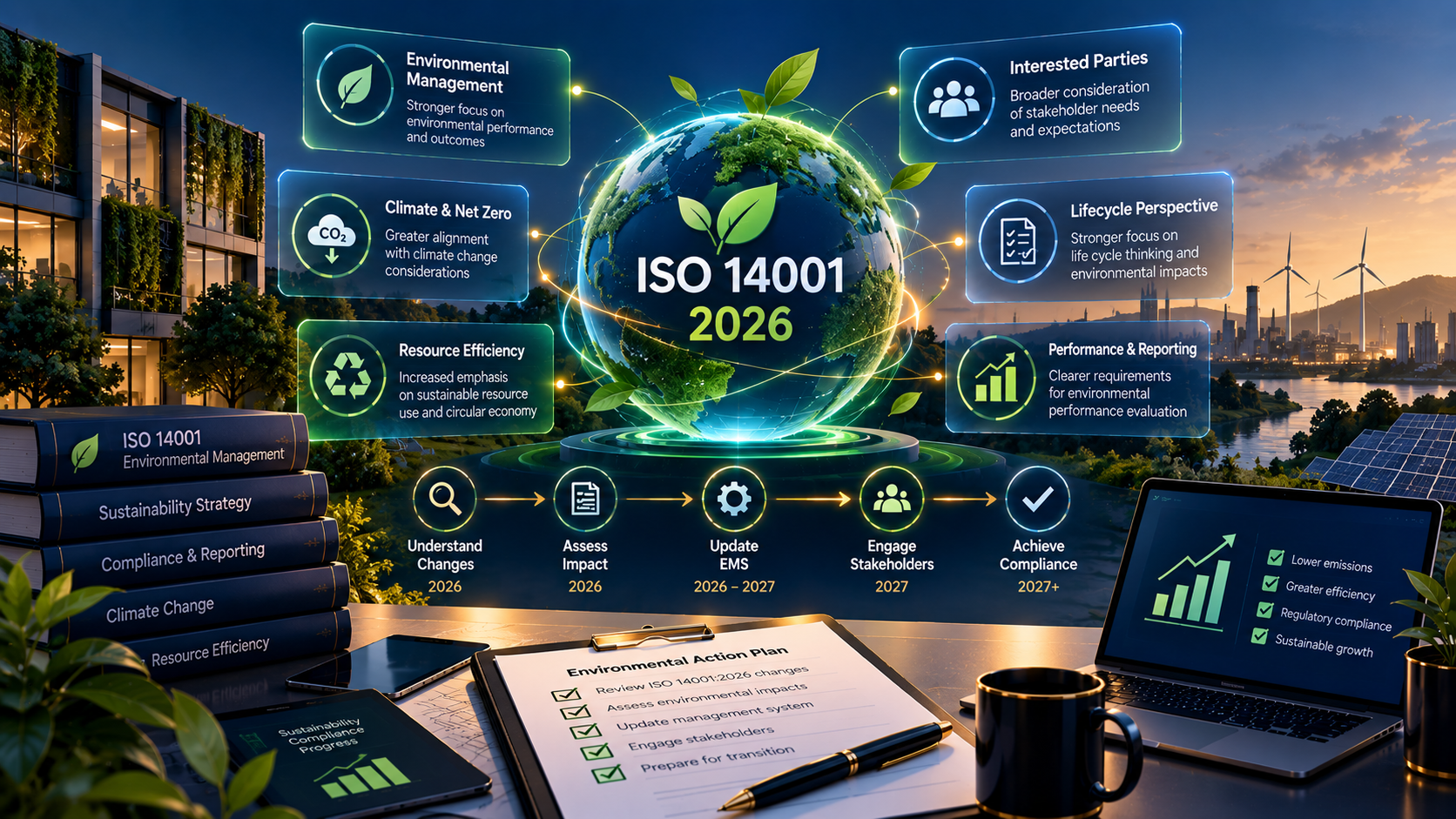
ISO 14001 is the world’s most widely used environmental management system (EMS) standard. The current edition, ISO 14001:2015, has guided organisations’ approach to environmental management for over a decade. A significant revision is now underway, with the updated standard expected to be published in 2026.
For UK businesses currently certified to ISO 14001:2015, this revision will require active preparation. This guide explains what is changing, what it means in practice, and how to get ready.
Why is ISO 14001 being revised?
The 2015 revision was a major update that introduced risk-based thinking, lifecycle perspective, and strategic integration of environmental management. The 2026 revision builds on this foundation but responds to significant developments since 2015:
- Climate change has moved from a background concern to a central business risk. The 2015 edition requires organisations to consider climate change as an external context issue, but this requirement is seen as insufficient given the scale and urgency of climate-related risks.
- The circular economy and resource efficiency have become mainstream business considerations. The standard needs to better reflect the full lifecycle implications of products and services.
- Alignment with climate and sustainability reporting frameworks: including the Task Force on Climate-related Financial Disclosures (TCFD), the International Sustainability Standards Board (ISSB) standards, and the UK Government’s green finance agenda: requires the standard to speak more directly to these frameworks.
Key anticipated changes
Strengthened climate change requirements
This is the most significant anticipated change. The revision is expected to require organisations to:
- Explicitly assess climate-related risks and opportunities as part of determining the context of the organisation (clause 4.1)
- Consider the impacts of climate change on environmental aspects: for example, how changing weather patterns affect energy consumption, water use, or flood risk at your sites
- Address climate change mitigation and adaptation in environmental objectives where relevant
For many organisations, this will require a more structured climate risk and opportunity assessment than is currently required. Tools such as the TCFD framework or scenario analysis approaches can support this.
Alignment with the updated High Level Structure
All ISO management system standards are being updated to align with the revised High Level Structure (HLS) Annex SL. This brings a consistent structure, terminology, and core text across ISO 9001, ISO 14001, ISO 45001, ISO 27001, and other management system standards.
For organisations running integrated management systems, this alignment is welcome: it will make integration easier and reduce duplication. For organisations with standalone EMS certifications, the structural changes should be relatively straightforward to accommodate.
Lifecycle thinking and value chain impacts
The 2015 edition introduced lifecycle perspective as a requirement. The revision is expected to strengthen this, particularly around:
- Upstream environmental impacts from procurement and supply chain activities
- Downstream impacts from product and service use and end-of-life
- Scope 3 greenhouse gas emissions, where these are material
Organisations that have not yet engaged seriously with lifecycle thinking in their EMS may need to invest in supplier engagement, product lifecycle analysis, or carbon footprint assessment as part of the transition.
Documented information and evidence of performance
The revision may introduce more specific requirements for measuring and communicating environmental performance, including clearer links to external reporting frameworks. This reflects the growing expectation from investors, customers, and regulators for credible, verified environmental performance data.
Transition timeline
ISO typically allows a transition period of three years from the publication date of a new edition. If ISO 14001:2026 is published in mid-2026, the transition deadline for organisations certified to ISO 14001:2015 would fall around mid-2029.
However, experience from previous transitions suggests that organisations that begin preparing early are much better positioned:
- Year 1 (2026–2027): Familiarise yourself with the new edition, conduct a gap analysis, develop your transition plan
- Year 2 (2027–2028): Implement required changes, update documentation, update staff training
- Year 3 (2028–2029): Internal audit against new edition, arrange transition audit with certification body before the deadline
Starting in Year 3 consistently creates problems: audits are rushed, findings are more numerous, and transition audit slots are harder to schedule.
Sector-specific considerations
Manufacturing and engineering. The lifecycle and value chain requirements will require engagement with supply chain environmental impacts, including Scope 3 emissions.
Construction. Climate-related site hazards (flooding, heat, subsidence) will need to be integrated into environmental risk assessments.
Retail and logistics. Transportation and distribution emissions are significant Scope 3 sources that the revision will require more systematic assessment of.
Professional services. The main environmental impacts are often indirect (business travel, supply chain). The revised standard will push for more structured management of these.
Charities and public sector. Environmental management systems are increasingly expected in public procurement. The revision will raise the bar for what a credible EMS looks like.
Practical steps for certified organisations
Step 1: Stay informed. ISO publishes committee drafts for public comment. Your certification body will also communicate updates as the revision progresses. Subscribe to relevant communications now.
Step 2: Assess your climate risk and opportunity position. Do you currently have a structured assessment of how climate change affects your organisation’s environmental aspects and your business risks? If not, begin developing this: it will be required under the new edition and is increasingly expected by customers, investors, and regulators regardless.
Step 3: Review your lifecycle assessment activities. How thoroughly are you currently considering upstream and downstream environmental impacts? Identify where gaps exist.
Step 4: Align your reporting. If your organisation produces an environmental report, sustainability report, or climate disclosure, begin aligning this with emerging frameworks such as TCFD or the ISSB standards. ISO 14001:2026 is likely to reference these explicitly.
Step 5: Plan your budget. The transition will require internal resource, documentation work, staff training, and a transition audit. Build this into your planning and budget cycle.
How Elmar can help
Elmar Risk Management supports organisations through ISO 14001 certification and transition from the initial gap analysis through to the certification audit. We ensure your EMS reflects how your organisation actually operates, not just how a template says it should.
As the 2026 revision develops, we will be providing updated guidance and transition support. Get in touch to discuss your ISO 14001 needs.
Share:
LinkedIn