
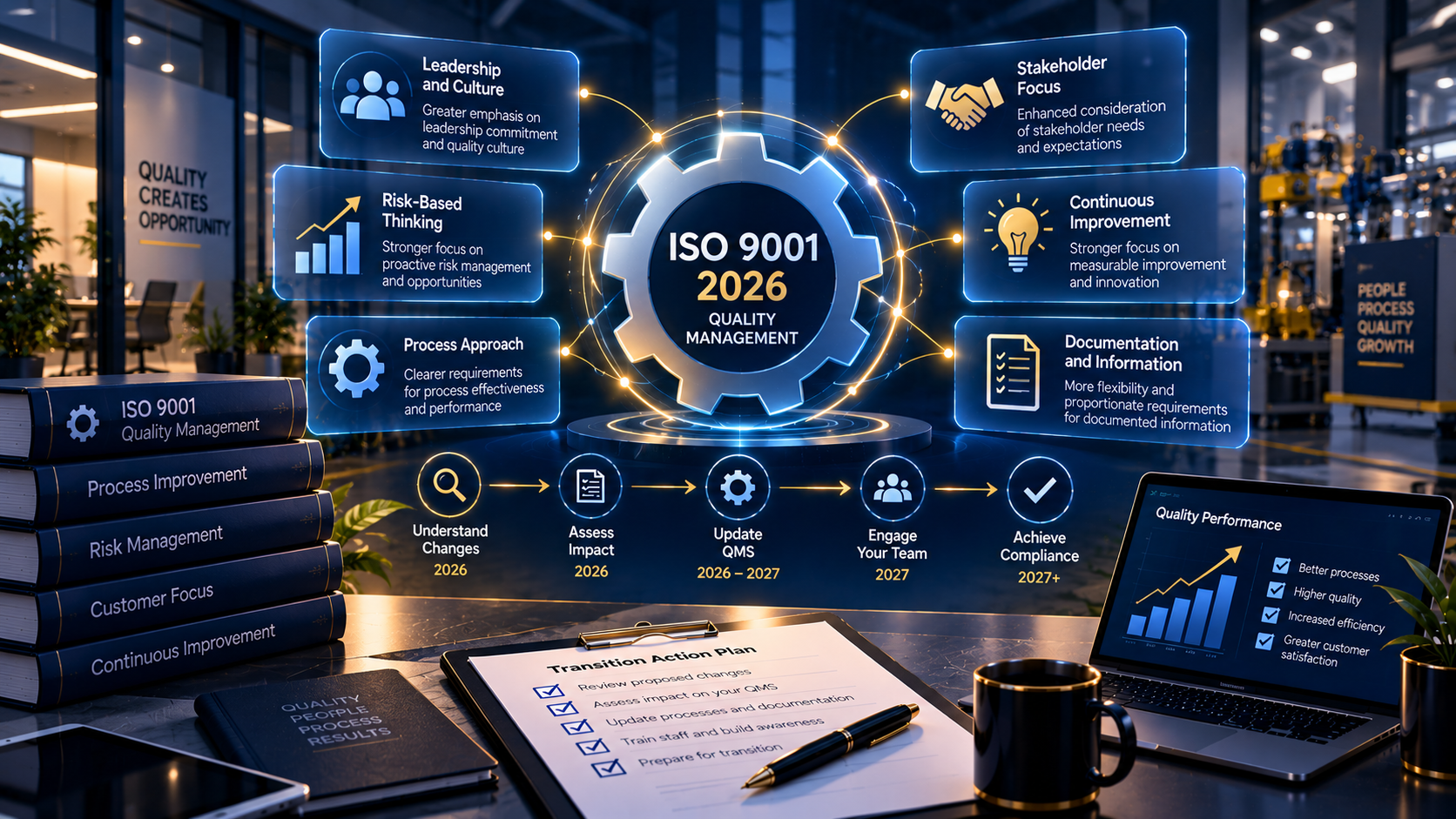
ISO 9001 is the world’s most widely used management system standard. The current edition, ISO 9001:2015, was a transformative update that introduced risk-based thinking, leadership accountability, and a context-driven approach to quality management. A further revision is now in development, with the updated standard expected around 2026.
This article examines the key anticipated changes, their practical implications, and what UK businesses certified to ISO 9001:2015 should be doing to prepare.
The ISO 9001:2015 revolution: and what comes next
When ISO 9001:2015 replaced ISO 9001:2008, it fundamentally changed the nature of quality management systems. The prescriptive, procedure-heavy approach of the 2008 edition gave way to a more principles-based, outcomes-focused framework. Risk-based thinking replaced the formal preventive action requirements. Leadership was made a top-level responsibility rather than a management representative function.
The 2026 revision is not expected to be as transformative as 2015 was, but it will bring meaningful changes: particularly around climate change and documented information.
Key anticipated changes
Climate change integration
The most widely anticipated change is the explicit requirement to consider climate change as part of determining the context of the organisation. ISO published an amendment to ISO 9001:2015 (Amendment 1:2024) that added the following to clause 4.1:
“The organisation shall determine whether climate change is a relevant issue.”
And to clause 4.2 (understanding the needs and expectations of interested parties):
“NOTE Relevant interested parties can have requirements related to climate change.”
These amendments were incorporated into ISO 9001:2015 as an interim measure, but the 2026 revision is expected to develop this more fully: potentially requiring a more structured assessment of climate-related risks and opportunities within the quality management context.
For most manufacturing and service businesses, this will involve considering how climate change affects:
- Operational continuity: Supply chain disruption from extreme weather, flooding of premises, heat-related impacts on processes or workforce
- Customer requirements: Growing customer expectations for environmental performance, supply chain traceability, and carbon footprint reporting
- Regulatory environment: UK and EU regulations around sustainability disclosure and environmental performance that affect how products and services must be specified or documented
Documented information requirements
ISO 9001:2015 significantly reduced the mandatory documented information requirements compared to 2008. The 2026 revision is expected to refine these requirements further: potentially providing clearer guidance on what documented information is necessary for effective operation versus what is optional.
This may be welcome for organisations that have over-documented their QMS, producing procedures and work instructions that are rarely consulted and quickly become out of date.
Knowledge management
ISO 9001:2015 introduced explicit requirements for managing organisational knowledge (clause 7.1.6). The 2026 revision is expected to develop this further, reflecting the growing recognition that knowledge retention: particularly in the face of high staff turnover, remote working, and AI-assisted processes: is a genuine quality risk.
Organisations that have treated the knowledge management clause as a checkbox item should consider whether their approach genuinely protects against knowledge loss.
Alignment with the updated High Level Structure
Like all ISO management system standards, ISO 9001 will be updated to align with the revised High Level Structure. This provides a common framework across ISO 9001, ISO 14001, ISO 45001, ISO 27001, and other standards: making integrated management systems easier to develop and maintain.
For organisations running integrated systems, this alignment is a significant benefit. The terminology and structure become consistent, reducing duplication and making the system easier to audit.
What this means for organisations certified to ISO 9001:2015
If your QMS is genuinely embedded
If your QMS is a living system: used in management reviews, driving process improvement, and genuinely consulted by staff: transitioning to the 2026 edition will be relatively straightforward. You will need to:
- Conduct a gap analysis against the new edition once it is published
- Update documentation where necessary (likely modest changes for most organisations)
- Address any new requirements (for example, climate change assessment)
- Complete an internal audit against the new edition
- Arrange a transition audit with your certification body
If your QMS is primarily a certification document
Organisations that certified in a hurry, or whose QMS has not been seriously maintained since certification, face a more challenging transition. The same gap analysis will reveal not just the delta between the 2015 and 2026 editions but also drift from the 2015 requirements themselves.
This is not unusual: and it is better discovered in a planned gap analysis than at a surveillance audit or transition audit.
The transition timeline
ISO 9001:2026 is expected to be published in 2026. A three-year transition period would place the deadline around 2029. However, the pattern from previous transitions is consistent: organisations that begin in Year 3 face higher costs and more disruption.
Common mistakes organisations make in transitions
Treating the transition as documentation work. The real work of a standards transition is in the implementation, not the paperwork. Documents that are updated but not communicated or embedded will not survive an audit.
Underestimating the climate change requirement. For some sectors and organisations, the climate change assessment requirements will require genuinely new thinking, new data, and potentially new processes. This is not a form to fill in: it is a real assessment.
Leaving it too late. The three-year transition period sounds generous but disappears quickly when combined with planned surveillance audit cycles, management review schedules, and competing priorities.
Not informing leadership. A QMS transition requires leadership involvement: particularly around the context review, management review inputs, and quality objectives. Brief your board and senior management early.
How Elmar can help
Elmar Risk Management guides businesses through ISO 9001 certification and standards transitions. From the initial gap analysis through to the certification audit, we ensure your QMS reflects your actual processes, meets the standard’s requirements, and adds real value to your business.
As the 2026 edition is developed and published, we will be updating our guidance and transition support accordingly. Get in touch to discuss your ISO 9001 needs.
Share:
LinkedIn