
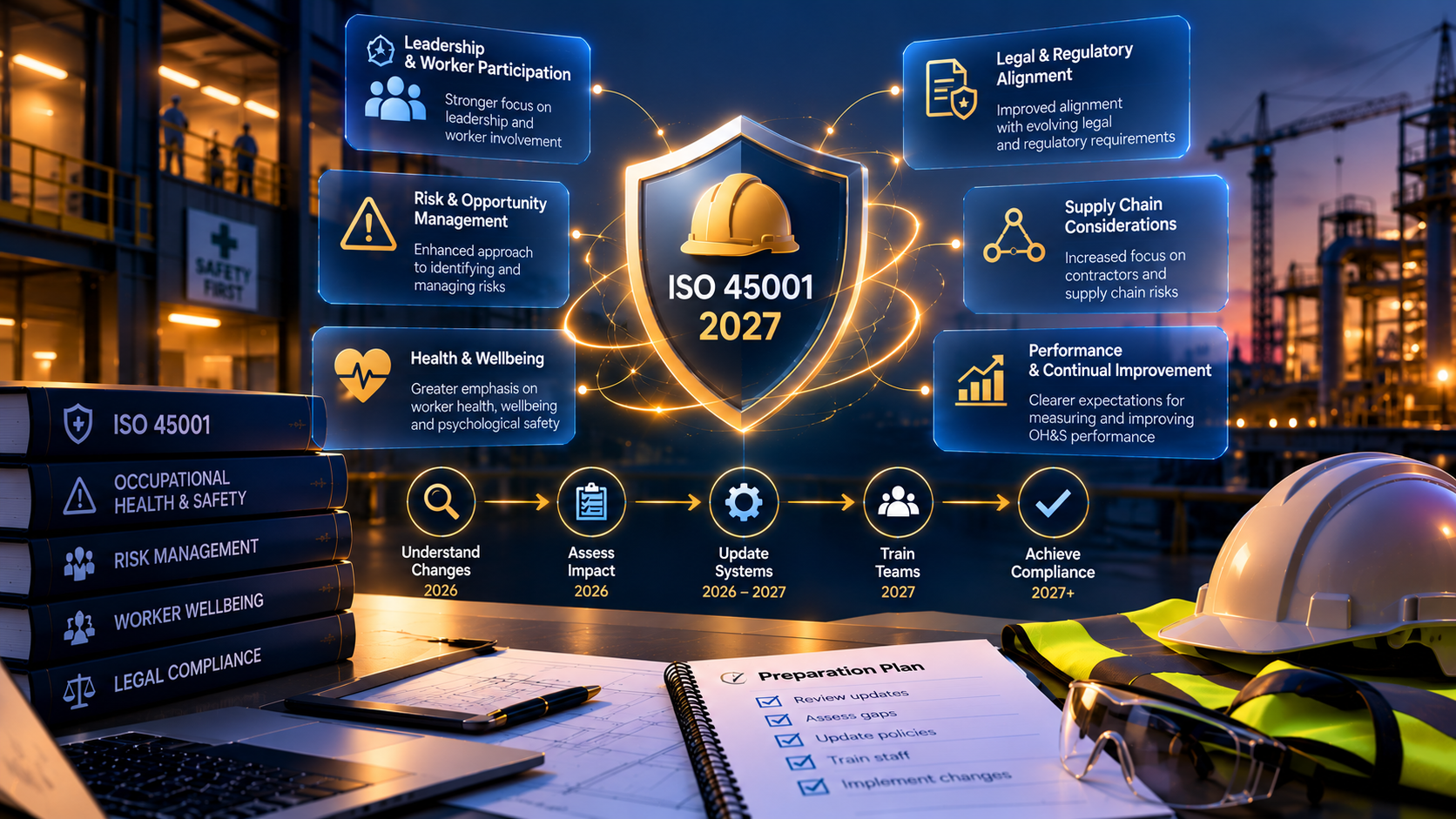
The revision of ISO 45001 is one of the most significant standards updates on the horizon for UK businesses with occupational health and safety management systems. With the revised standard anticipated for publication around 2027, now is the time to understand what is changing and what it means in practice for your organisation.
The context: why update a standard that is working?
ISO 45001:2018 successfully unified global occupational health and safety management into a single, internationally recognised standard, replacing OHSAS 18001 and dozens of national equivalents. Its adoption has been widespread and, by most accounts, it has improved health and safety management in organisations that have implemented it seriously.
So why revise it? Three main reasons:
The world of work has changed. Since 2018, remote and hybrid working has become mainstream, the gig economy has grown, and supply chains have become more complex. The 2018 standard does not adequately address the health and safety implications of these structural shifts.
Mental health is now a central occupational health issue. Work-related stress, burnout, and poor mental wellbeing are among the leading causes of workplace absence in the UK. The 2018 standard touches on this but does not address it with sufficient specificity.
Climate change is creating new occupational hazards. Extreme heat, flooding, poor air quality, and other climate-related conditions are increasingly recognised as occupational health and safety risks. The standard needs to reflect this.
Implications for UK businesses
If you are currently certified to ISO 45001:2018
Your existing certification remains valid until the transition deadline set by your certification body following publication of the 2027 edition. You do not need to act immediately: but you should begin planning.
Start with a readiness review. Understand where your current OHSMS addresses the anticipated new requirements and where gaps exist. This is most efficiently done once the committee draft stabilises, but an initial review of your psychological health and contractor management arrangements can begin now.
Budget for the transition. Transitioning to a new edition involves documentation updates, training, a gap analysis, an internal audit against the new edition, and a transition audit with your certification body. This is not a trivial investment, particularly for organisations that have multiple sites or complex supply chains.
Communicate to leadership. The ISO 45001 revision: particularly its mental health requirements: has significant implications for how boards and senior management think about occupational health. Begin briefing leadership now so that the transition is not treated as a compliance exercise but as an opportunity to genuinely strengthen your approach.
If you are not yet certified to ISO 45001
If you are planning to pursue ISO 45001 certification, you face a choice: certify to the current 2018 edition and transition later, or wait for the 2027 edition and certify directly against it.
In most cases, certifying to the 2018 edition now makes sense: provided the timeline works for your business needs. A certification gained now will still be valid during the transition period, and the experience of implementing the 2018 edition will make transitioning to 2027 significantly easier than starting fresh.
For health and safety consultants and practitioners
The mental health and psychological wellbeing requirements in the anticipated revision will require a broader skill set than traditional safety management. Practitioners who can support clients with psychological risk assessment, stress management frameworks, and wellbeing programme design will be in increasing demand.
The UK regulatory backdrop
The ISO 45001 revision does not occur in isolation. In the UK, the Health and Safety at Work Act 1974 and the Management of Health and Safety at Work Regulations 1999 already place duties on employers that encompass psychological as well as physical health. The HSE has published significant guidance on work-related stress and mental health, and enforcement action in this area is increasing.
ISO 45001:2027 will provide a structured framework for meeting these existing legal duties more systematically: but it is important to recognise that the legal obligations already exist. The standard is a tool for meeting them, not a substitute for understanding them.
Practical steps to take now
-
Review your current psychological hazard and risk assessment approach. Do you currently identify and assess work-related stress as a hazard? If not, the HSE’s Management Standards approach provides a practical starting framework.
-
Assess contractor health and safety engagement. How do you communicate your health and safety requirements to contractors? How do you monitor compliance? Document your current approach and identify gaps.
-
Review your worker participation mechanisms. How do remote and contracted workers engage with your health and safety management processes? Are there gaps that could become nonconformities under the revised standard?
-
Plan CPD and team upskilling. The people responsible for managing your OHSMS will need to build knowledge in psychological health, contractor management, and (where relevant) climate-related hazard assessment.
-
Keep an eye on the ISO publication timeline. The certification body network and ISO’s own communications will provide updates as the revision progresses. Subscribe to updates from your certification body.
If you would like to discuss ISO 45001 transition planning or health and safety management support, contact Elmar Risk Management. Peter Berry is an ISO Lead Auditor qualified across ISO 45001 and provides practical, grounded support through every stage of the certification journey.
Share:
LinkedIn