
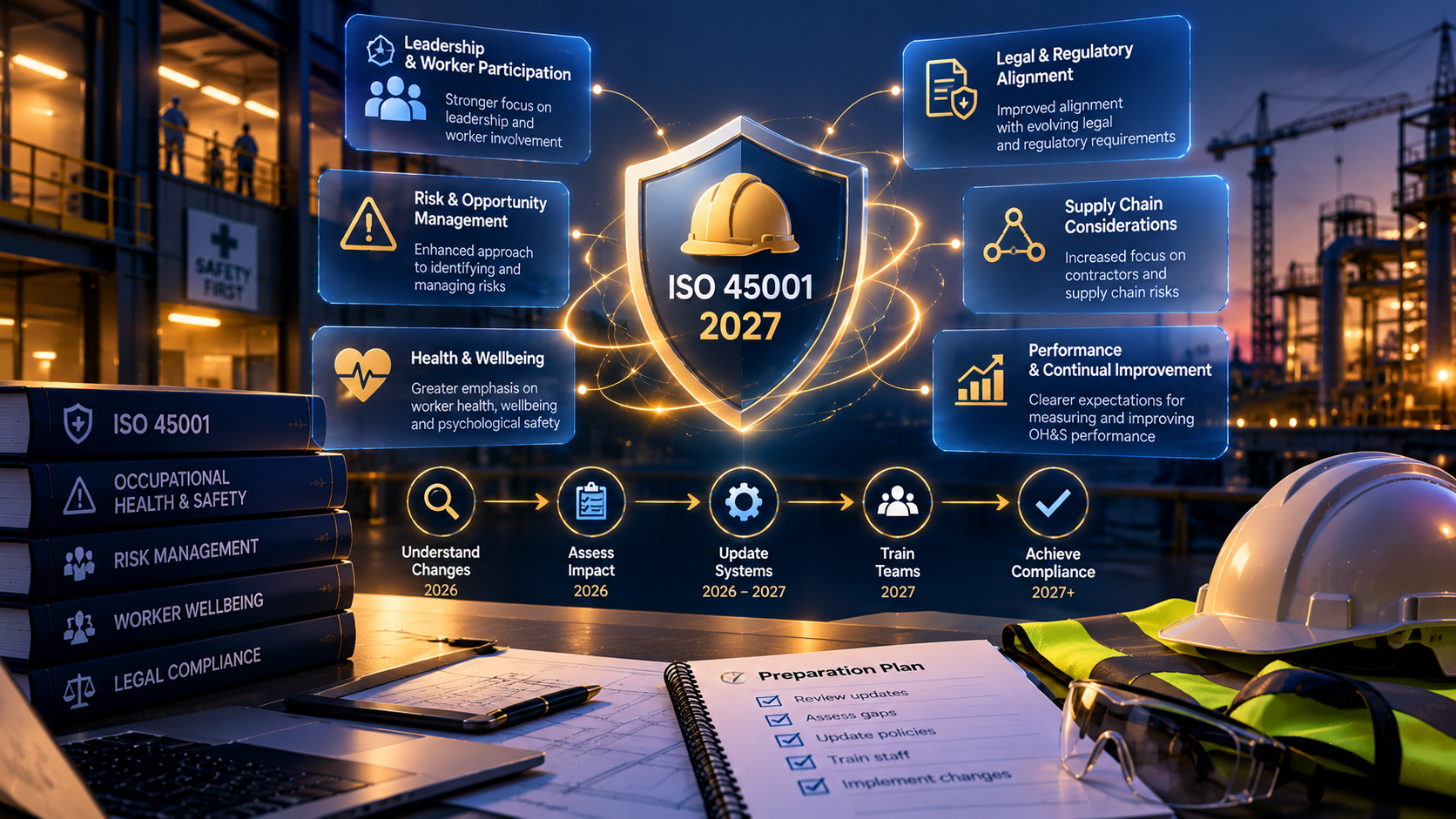
ISO 45001:2018 established the first truly international standard for Occupational Health and Safety Management Systems (OHSMS). Since its publication, it has been widely adopted by organisations across the UK and globally, replacing the earlier OHSAS 18001 framework.
The standard is now under revision, with ISO 45001:2027 expected to be published around 2027. While the revision is still in development, the direction of change is clear from the published committee work, and organisations currently certified to ISO 45001:2018 should begin preparing now.
Why is ISO 45001 being revised?
Standards are reviewed on a regular cycle: typically every five years: to ensure they remain relevant to changing working practices, emerging risks, and evolving regulatory environments. For ISO 45001, the committee has identified several areas where the 2018 edition needs strengthening:
- Mental health and psychological wellbeing are now widely recognised as occupational health risks, but the 2018 edition does not address them explicitly. The revision is expected to change this.
- Contractor and supply chain management has become more complex, and the requirements for managing health and safety risks in extended supply chains needed strengthening.
- Worker participation was a key theme of the 2018 edition but has been identified as an area where requirements can be made clearer and more effective in practice.
- Remote and hybrid working has become widespread since 2018, creating occupational health and safety considerations that the current standard does not specifically address.
Key anticipated changes
Psychological health and wellbeing
The most significant anticipated change is the explicit inclusion of psychological health alongside physical safety. The revision is expected to require organisations to:
- Identify and assess psychological hazards and risks (work-related stress, burnout, harassment, bullying)
- Implement controls to manage psychological risks, not just physical ones
- Monitor worker wellbeing as part of occupational health performance measurement
For UK businesses, this aligns with the Health and Safety Executive’s increased focus on work-related stress and mental health, and with the growing legal and regulatory environment around employer duty of care for mental health.
Worker consultation and participation
ISO 45001:2018 includes requirements for worker consultation and participation, but the revision is expected to strengthen these: particularly for:
- Contractors and temporary workers, who often receive less robust health and safety engagement than permanent employees
- Remote workers, for whom participation in health and safety processes can be more difficult to facilitate
- Workers in hazardous roles, where participation in risk assessment is particularly important
Contractor and supply chain management
The revision is anticipated to introduce more specific requirements for managing occupational health and safety risks across supply chains and contracted operations. This reflects a growing recognition that organisations bear responsibility for health and safety risks associated with their contractors and subcontractors, not just their direct employees.
Climate change and environmental hazards
In line with the broader direction of ISO management system standards, the revision is expected to require more explicit consideration of how climate-related hazards (extreme heat, flooding, air quality, and so on) create occupational health and safety risks.
Alignment with the updated High Level Structure
All ISO management system standards are being progressively aligned to the updated High Level Structure (HLS), which provides a common framework, terminology, and structure. The ISO 45001 revision will update the standard’s structure and language to align with this common framework, making it easier to integrate with other management systems such as ISO 14001 and ISO 9001.
What the transition will look like
When ISO 45001:2027 is published, there will be a transition period: typically three years: during which organisations certified to the 2018 edition will be expected to transition to the new edition. Certification bodies will communicate specific timelines.
Based on experience with previous transitions (particularly ISO 27001 in 2022 and ISO 9001 in 2015), the transition involves:
- Gap analysis against the new edition to identify what needs to change
- Documentation updates to reflect new or revised requirements
- Implementation of any new controls or processes (for example, psychological health risk assessment)
- Internal audit against the new edition
- Transition audit conducted by your certification body
Preparing now
Even though the 2027 revision has not yet been published, there are practical steps organisations can take today:
Assess your current approach to psychological health. If your OHSMS does not currently include a structured approach to identifying and managing psychological hazards, begin building this in. This is good practice regardless of the standard revision.
Review your contractor management arrangements. Map out how occupational health and safety requirements are communicated to and monitored for contractors and subcontractors.
Strengthen worker participation mechanisms. Review how you consult workers: particularly contractors and remote employees: on health and safety matters.
Stay engaged with your certification body. They will communicate the transition timeline when the new edition is published.
Consider a preliminary gap analysis. Once the committee draft reaches a sufficiently mature stage, a gap analysis against the anticipated requirements will give you a head start on the transition.
How Elmar can help
Elmar Risk Management’s Peter Berry is an ISO Lead Auditor qualified across ISO 45001, bringing hands-on practical expertise to ISO 45001 implementation and transition work.
Whether you are preparing for your first ISO 45001 certification, preparing for a surveillance audit under the 2018 edition, or beginning to plan for the 2027 transition, we can support you. Get in touch to discuss your occupational health and safety management needs.
Share:
LinkedIn